Implementation of cons cell operations. More...
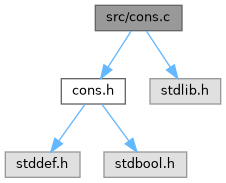
Go to the source code of this file.
Functions | |
| static bool | cons_delete_p (struct cons **list, struct cons *cell, void *user) |
| static bool | cons_remove_p (struct cons **list, struct cons *cell, void *user) |
| struct cons ** | cons (struct cons **list, struct cons *cell) |
| Prepends a cons cell to a list. | |
| struct cons ** | cons_prepend (struct cons **list, struct cons *cell) |
| Prepends a cons cell to a list, returning the updated list pointer. | |
| struct cons ** | cons_loop (struct cons **list, bool(*pred)(struct cons **list, struct cons *cell, void *user), void *user) |
| Loops through a list of cons cells, applying a predicate function to each cell. | |
| static bool | cons_find_p (struct cons **list, struct cons *cell, void *user) |
| struct cons ** | cons_find (struct cons **list, void *cell) |
| Finds the first cons cell in a list that matches a given identity. | |
| struct cons * | cons_delete (struct cons **list, void *car) |
Destructively deletes the first cons cell with the specified car value from the list. | |
| struct cons * | cons_remove (struct cons **list, struct cons *cell) |
| Destructively removes the specified cons cell from the list. | |
| void | cons_reverse (struct cons **list) |
| Reverses a linked list of cons cells in place. | |
| size_t | cons_length (const struct cons *cell) |
| Computes the length of a linked list of cons cells. | |
| struct cons * | cons_last (struct cons *cell) |
| Returns the last cons cell in a linked list of cons cells. | |
| struct cons * | cons_nth (struct cons *cell, size_t nth) |
| Returns the n'th cons cell in a linked list of cons cells. | |
| struct cons * | cons_member (struct cons *cell, void *car) |
Returns the first cons cell in a linked list of cons cells whose car field matches the specified value. | |
| struct cons * | cons_append (struct cons *cell1, struct cons *cell2) |
| Appends one list of cons cells to another. | |
| struct cons * | cons_heap (void *car) |
| Allocates a new cons cell on the heap. | |
| void | cons_free (struct cons *cell) |
| Frees a heap-allocated cons cell. | |
Detailed Description
Implementation of cons cell operations.
This file implements functions for manipulating cons cells, which are fundamental data structures in Lisp-like languages. The functions link caller-provided cons cells into lists, remove cells from a list, and reverse a list of cons cells. The operations work with the structure defined in cons.h to link and manipulate linked lists and other complex data structures.
Definition in file cons.c.
Function Documentation
◆ cons()
Prepends a cons cell to a list.
- Parameters
-
list Pointer to the list head to which the new cell will be prepended. This is a pointer to a pointer to a cons cell, allowing the function to update the list pointer to point to the new cell. cell The cons cell to prepend to the list.
- Returns
- Pointer to the
cdrfield of the new cell for chaining. Use the return value to further add elements to the list by chaining additional cons cells together.
The cons function takes a pointer to a list (which is a pointer to a cons cell) and a cons cell to prepend. It initialises the cdr of the new cell to point to the existing list and updates the list pointer to point to the new cell. This effectively adds the new cell to the front of the list. The cons function is a fundamental operation in Lisp-like languages, where it is used to construct lists and other complex data structures. The car field of the new cell can hold any type of data, while the cdr field is specifically designed to link to another cons cell, facilitating the construction of linked lists and other complex data structures. The cons function allows for efficient list manipulation by enabling the addition of new elements to the front of the list without needing to traverse the entire list, making it a powerful tool for building and modifying lists in a flexible and efficient manner.
Definition at line 24 of file cons.c.
◆ cons_append()
Appends one list of cons cells to another.
- Parameters
-
cell1 The first list to which the second list will be appended. This list will be modified to include the second list at its end. cell2 The second list to append to the first list. This list will not be modified, but its cells will be linked into the first list.
- Returns
- Pointer to the head of the combined list, which is the same as
cell1if it is not empty, orcell2ifcell1is empty.
This function takes two lists of cons cells and appends the second list to the end of the first list. If the first list is empty (i.e., if cell1 is CONS_NIL), it simply returns cell2 as the new combined list. If the first list is not empty, it finds the last cell of the first list and updates its cdr pointer to point to the head of the second list, effectively linking the two lists together. The function then returns a pointer to the head of the combined list, which is the same as cell1.
Definition at line 151 of file cons.c.
◆ cons_delete()
Destructively deletes the first cons cell with the specified car value from the list.
- Parameters
-
list Pointer to the list head. car The value to match for deletion.
- Returns
- Pointer to the deleted cons cell, or
CONS_NILif no matching cell was found.
This function traverses the list of cons cells, looking for the first cell whose car field matches the specified value. If such a cell is found, it is removed from the list by updating the cdr pointer of the previous cell (or the head pointer if the cell to delete is the first cell) to point to the next cell, effectively bypassing the deleted cell. The function then returns a pointer to the deleted cell. If no matching cell is found after traversing the entire list, the function returns CONS_NIL to indicate that no deletion occurred. This operation is destructive because it modifies the original list structure by removing a cell from it. The caller is responsible for managing the memory of the deleted cell if necessary, as this function does not free the memory of the deleted cell; it only removes it from the list.
Definition at line 71 of file cons.c.
◆ cons_delete_p()
◆ cons_find()
Finds the first cons cell in a list that matches a given identity.
- Parameters
-
list Pointer to the list head to search through. This is a pointer to a pointer to a cons cell. cell The cons cell to find by identity.
- Returns
- Pointer to the list pointer of the first cons cell that matches the specified identity, or
NULLif no such cell is found.
◆ cons_find_p()
◆ cons_free()
| void cons_free | ( | struct cons * | cell | ) |
Frees a heap-allocated cons cell.
Definition at line 168 of file cons.c.
◆ cons_heap()
| struct cons * cons_heap | ( | void * | car | ) |
Allocates a new cons cell on the heap.
Allocates memory for a new cons cell and initialises it with the provided car value. The caller is responsible for freeing the allocated memory when it is no longer needed.
- Parameters
-
car The value to store in the carfield of the new cons cell.
- Returns
- Pointer to the newly allocated cons cell, or
CONS_NILif memory allocation fails.
Definition at line 160 of file cons.c.
◆ cons_last()
Returns the last cons cell in a linked list of cons cells.
- Parameters
-
cell The head of the list to find the last cell of, or CONS_NILfor an empty list.
- Returns
- Pointer to the last cons cell in the list, or
CONS_NILif the list is empty.
This function iteratively traverses the linked list of cons cells until it reaches the last cell, which is identified by having its cdr field equal to CONS_NIL. It returns a pointer to this last cell. If the input list is empty (i.e., if the input pointer is CONS_NIL), the function returns CONS_NIL to indicate that there are no cells in the list.
Definition at line 120 of file cons.c.
◆ cons_length()
| size_t cons_length | ( | const struct cons * | cell | ) |
Computes the length of a linked list of cons cells.
- Parameters
-
cell The head of the list to compute the length of, or CONS_NILfor an empty list.
- Returns
- The number of cons cells in the list.
This function iteratively traverses the linked list of cons cells, counting the number of cells until it reaches the end of the list (indicated by CONS_NIL). It returns the total count as the length of the list.
◆ cons_loop()
| struct cons ** cons_loop | ( | struct cons ** | list, |
| bool(*)(struct cons **list, struct cons *cell, void *user) | pred, | ||
| void * | user | ||
| ) |
Loops through a list of cons cells, applying a predicate function to each cell.
- Parameters
-
list Pointer to the list head to loop through. This is a pointer to a pointer to a cons cell. pred A predicate function that takes a pointer to the current list pointer, the current cons cell, and a user-defined pointer. The predicate should return trueif the current cell matches the desired condition, andfalseotherwise.user A user-defined pointer that can be passed to the predicate function for additional context or data needed for the predicate's logic.
- Returns
- Pointer to the list pointer of the first cons cell for which the predicate returns
true, orNULLif no such cell is found. The returned pointer allows the caller to modify the list starting from the found cell if needed. If the predicate does not find a matching cell in the list, the function returnsNULLto indicate that the search was unsuccessful. This design allows the function to signal the absence of a matching cell without returning a pointer to a cons cell, which would be misleading since it would suggest that a valid cell was found when in fact it was not. By returningNULL, the function provides a clear and unambiguous way to indicate that the search was unsuccessful.
Definition at line 35 of file cons.c.
◆ cons_member()
Returns the first cons cell in a linked list of cons cells whose car field matches the specified value.
- Parameters
-
cell The head of the list to search, or CONS_NILfor an empty list.car The value to match in the carfield of the cons cells.
- Returns
- Pointer to the first matching cons cell, or
CONS_NILif no match is found.
Iteratively traverses the linked list of cons cells, comparing the car field of each cell with the specified value. If a match is found, a pointer to the matching cell is returned. If the end of the list is reached without finding a match, CONS_NIL is returned.
Definition at line 142 of file cons.c.
◆ cons_nth()
Returns the n'th cons cell in a linked list of cons cells.
- Parameters
-
cell The head of the list to find the n'th cell of, or CONS_NILfor an empty list.nth The zero-based index of the cell to retrieve.
- Returns
- Pointer to the n'th cons cell in the list, or
CONS_NILif the index is out of bounds.
Iteratively traverses the linked list of cons cells, counting the cells as it goes. When the count reaches the specified index nth, it returns a pointer to the current cell. If the end of the list is reached before finding the n'th cell (i.e., if the input pointer becomes CONS_NIL), the function returns CONS_NIL to indicate that the index is out of bounds.
◆ cons_prepend()
Prepends a cons cell to a list, returning the updated list pointer.
- Parameters
-
list Pointer to the list head to which the new cell will be prepended. cell The cons cell to prepend to the list.
- Returns
- Pointer to the updated list pointer, now pointing to the new cell.
A wrapper around cons that allows convenient chaining of cons cell additions without separately managing the list pointer.
◆ cons_remove()
Destructively removes the specified cons cell from the list.
- Parameters
-
list Pointer to the list head. cell The cons cell to remove from the list, matched by identity.
- Return values
-
The removed cons cell if the specified cell was found and removed.
c CONS_NIL if the specified cell was not found in the list.
Traverses the list of cons cells, looking for the specified cell. If the cell is found, it is removed from the list by updating the cdr pointer of the previous cell (or the head pointer if the cell to remove is the first cell) to point to the next cell, thereby bypassing the removed cell.
◆ cons_reverse()
| void cons_reverse | ( | struct cons ** | list | ) |
Reverses a linked list of cons cells in place.
This function takes a pointer to the head of a linked list of cons cells and reverses the order of the cells in the list. It iteratively traverses the list, reassigning the cdr pointers to point to the previous cell, effectively reversing the list.
- Parameters
-
list The list to reverse. This is a pointer to the head of the list, and it will be updated to point to the new head of the reversed list.
Definition at line 91 of file cons.c.