Leap year function implementations. More...
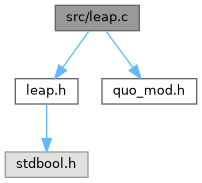
Go to the source code of this file.
Functions | |
| bool | is_leap (int year) |
| Determine if a year is a leap year. | |
| int | leap_add (int year) |
| Adds one for a leap year otherwise zero. | |
| int | leap_thru (int year) |
| Leap years completed from year 0 up to but not including the first day of the specified year. | |
| int | leap_day (int year) |
| Counts leap-adjusted days up to some year. | |
| struct leap_off | leap_off (int year, int day_off) |
| Offsets year and day of year. | |
| int | leap_mday (int year, int month) |
| Day of month from year and month. | |
| int | leap_yday (int year, int month) |
| Day of year from year and month. | |
| struct leap_date | leap_date (int year, int day_off) |
| Date from year and day of year. | |
| struct leap_off | leap_from (int year, int month, int day) |
| Day from year, month and day of month. | |
| struct leap_date | leap_abs_date (int day_off) |
| Absolute date from day of year. | |
| int | leap_abs_from (int year, int month, int day) |
| Absolute date from year, month, and day of month. | |
Detailed Description
Leap year function implementations.
Implements functions to determine if a year is a leap year, count leap years up to a given year, and calculate leap-adjusted days.
- Copyright
- 2025, Roy Ratcliffe, Northumberland, United Kingdom
Definition in file leap.c.
Function Documentation
◆ is_leap()
| bool is_leap | ( | int | year | ) |
Determine if a year is a leap year.
Is a year a leap year? A year is a leap year if it is divisible by four, except for years that are divisible by 100, unless they are also divisible by 400.
- Parameters
-
year The year to check.
- Return values
-
true if the year is a leap year. false if the year is not a leap year.
◆ leap_abs_date()
| struct leap_date leap_abs_date | ( | int | day_off | ) |
Absolute date from day of year.
Converts a day offset (from year 0) into a (year, month, day) date. The absolute day is anchored to year 0 such that day 0 corresponds to 0-01-01, making leap_day(0) == 0. Absolute days differ from Unix epoch days (which start at 1970-01-01).
- Parameters
-
day_off The absolute day offset, starting from 0 for the first day of year 0.
- Returns
- The leap_date structure (year, month, day) corresponding to the absolute day.
◆ leap_abs_from()
| int leap_abs_from | ( | int | year, |
| int | month, | ||
| int | day | ||
| ) |
Absolute date from year, month, and day of month.
Converts a (year, month, day) date into an absolute day offset from year 0 such that day 0 corresponds to 0-01-01, making leap_day(0) == 0. The absolute day is anchored at year 0, not Unix epoch (1970-01-01).
- Parameters
-
year The year. month The month, starting from 1 for January. day Day of the month, starting from 1 for the first day of the month.
- Returns
- The absolute day offset from year 0.
◆ leap_add()
| int leap_add | ( | int | year | ) |
Adds one for a leap year otherwise zero.
Answers 1 if the year is a leap year, otherwise answers 0. This is the same result as is_leap() except that the result is an explicit integer; 1 for leap years, 0 for non-leap years.
Compute the number of days in a given year as:
- Parameters
-
year The year to check.
- Return values
-
1 if the year is a leap year. 0 if the year is not a leap year.
◆ leap_date()
Date from year and day of year.
Adjust the day so that it sits in-between 1 and 365 (or 366) inclusively. Returns the year, month, and day of the month for the given year and day of year. The day of the month is adjusted to be 1-based, meaning it starts from 1 for the first day of the month.
- Parameters
-
year The year. day_off Day of the year offset, starting from 0 for first of January.
- Return values
-
leap_date.year The year. leap_date.month The month, starting from 1 for January. leap_date.day The day of the month, starting from 1 for the first day of the month.
◆ leap_day()
| int leap_day | ( | int | year | ) |
Counts leap-adjusted days up to some year.
Counts the number of days completed up to but not including the first day of the year.
- Parameters
-
year The year to check.
- Returns
- The number of leap-adjust days completed up to but not including the first day of the given year.
◆ leap_from()
| struct leap_off leap_from | ( | int | year, |
| int | month, | ||
| int | day | ||
| ) |
Day from year, month and day of month.
Adjusts the month so that it sits in-between 1 and 12 inclusively. The month offsets the year. Returns the absolute date from the given year, month, and day of month.
- Parameters
-
year The year. month The month, starting from 1 for January. day The one-based day of the month, starting from 1 for the first day of the month.
- Returns
- The absolute date as the number of days since the epoch.
◆ leap_mday()
| int leap_mday | ( | int | year, |
| int | month | ||
| ) |
Day of month from year and month.
Returns the number of days in the month for the given year and month. Accounts for leap years in February.
- Parameters
-
year The year. month The month ordinal, starting from 1 for January.
- Return values
-
The number of days in the month, accounting for leap years in February.
◆ leap_off()
Offsets year and day of year.
Year and day of year from year and day of year. Adjust the day so that it sits in-between 0 and 365 or 366, inclusively.
The day adjusts to be within the range of 0 to 365 or 366 inclusively, and the year is adjusted accordingly.
This function ensures that the day of the year does not exceed the number of days in the year, accounting for leap years. If the day is negative or exceeds the number of days in the year, it adjusts the year and day accordingly. The day is adjusted to be 0-based, meaning it starts from 0 for the first day of the year. The year is adjusted to account for the number of days in the year, which can be either 365 or 366 depending on whether it is a leap year.
- Parameters
-
year The year. day_off The day of the year offset, starting from 0. It can be negative or exceed the number of days in the year.
- Return values
-
leap_off.year The year adjusted to account for the number of days in the year. The resulting year becomes normalised according to the day adjustment whether positive or negative. leap_off.day The adjusted day of the year, starting from 0 for the first day. The day is guaranteed to be within the bounds of the year. 0 <= day < 365 or 366 depending on whether it is a leap year.
◆ leap_thru()
| int leap_thru | ( | int | year | ) |
Leap years completed from year 0 up to but not including the first day of the specified year.
Counts the number of leap years that have occurred from year 0 up to but not including the first day of the given year. This is calculated as the number of years divisible by 4, minus those divisible by 100, plus those divisible by 400. This accounts for the rules of leap years in the Gregorian calendar.
- Parameters
-
year The target year up to which leap years should be counted.
- Returns
- The total number of leap years from year 0 through the specified year.
◆ leap_yday()
| int leap_yday | ( | int | year, |
| int | month | ||
| ) |
Day of year from year and month.
Returns the day of the year for the given year and month. The day of the year is calculated by summing the days in the months up to the given month, and adding an extra day if the month is after February in a leap year.
- Parameters
-
year The year. month The month ordinal, starting from 1 for January.
- Return values
-
The day of the year, starting from 0 for first of January.